Chess
Two players, one board, no luck: whoever plans better wins. With a clock it turns into a race against time; without one there’s room to think things through.
- 2 players
- 10–40 min
- ages 6+
- works without a TV
- vs. computer
Checkmate the opposing king.
How it works
- White moves first, then you take turns.
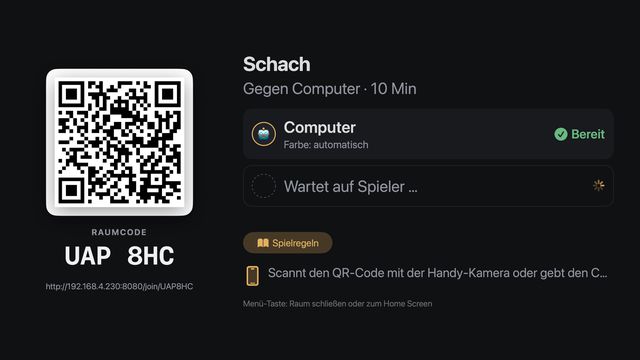
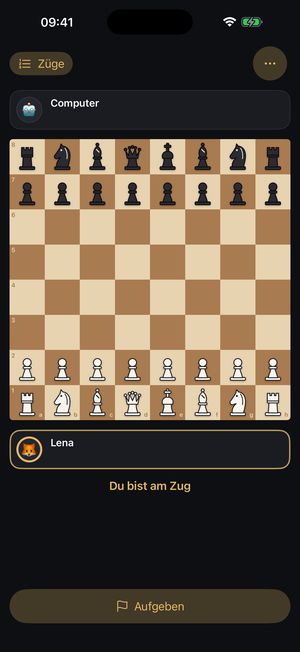
- Move on your phone: tap a piece, then its target square. With a TV, the board is shown for everyone.
- Castling, en passant and promotion work as usual.
- With a clock, whoever runs out of time first loses.
Good to know
- It's a draw on stalemate, threefold repetition, 50 moves without a capture or pawn move, or when nobody can checkmate anymore.
- On your own, you play against the computer.
On the TV and on your phone
What you see and tap, where and when – step by step:
- Choose Chess
- Set opponent and time control
- Open the room and join
- Pick a color and get ready
What makes Chess work
- No dice and no cards – every loss has a reason you can trace.
- Pick a clock from 5 to 30 minutes, or play without one.
- Playing alone? Practise against a simple computer opponent.
Pick Chess when two people want a calm, focused game.
Skip it when a bigger group wants to play at once or someone still has to learn the rules.
Frequently asked questions
How strong is the computer at chess?
There’s one difficulty level: the computer looks two half-moves ahead and picks, with a little randomness, among moves that are almost equally good. It’s a fair opponent for beginners and casual players; experienced players usually beat it.
What time controls are there for chess?
No clock, 5, 10 or 30 minutes per side, or 15 minutes plus 10 seconds per move. Whoever runs out of time loses – unless the opponent no longer has enough material to checkmate, in which case it’s a draw.
Can I promote a pawn to something other than a queen?
Yes. When your pawn reaches the last rank, your phone asks whether it should become a queen, rook, bishop or knight.
Can you offer a draw or resign in chess?
Yes, both from your phone; your opponent has to accept a draw offer. The game is drawn automatically on stalemate, threefold repetition, 50 moves without a capture or pawn move, and when neither side can checkmate any more.
Do I need a TV to play chess?
No. Two phones are enough: one hosts and the other joins with a code on the same Wi-Fi, or you play the computer on your own. With an Apple TV, iPad or Mac as the game table, the board is also shown large for anyone watching.
What happens if my chess opponent loses the connection?
Gather keeps their seat for three minutes. If they rejoin from the same device, the game picks up exactly where it was; if they don’t come back, they lose.
Variants and house rules
Gather plays by the rules above. Anything you can set in the app is marked – the rest are agreements you make at the table.
Five-minute blitz setting in Gather
Set the clock to 5 minutes before you start. Whoever runs out of time first loses – that brings in speed and mistakes you wouldn’t otherwise see. Good when several people want a turn one after another.
Long game with increment setting in Gather
With 15 + 10, each player gets 15 minutes plus 10 seconds after every move. Deep thinkers avoid time trouble, and the game still has an end. For no pressure at all, choose “No clock”.
Winner stays on table agreement
Several people want to play, but chess is for two: the winner faces the next challenger and the loser joins the back of the queue. Gather simply starts each game fresh – you keep track of the queue and the score yourselves.
Best of three, swapping colours table agreement
Two players play three games and swap colours each time so nobody always gets to start with White. Pick your colour in the lobby before each game and keep the score at the table.
Good for
Chess compared
- Chess or Stack Rush?2–6 players, skill and luck, calm
- Chess or Corner Chaos?1–6 players, mostly skill, very loud
- Chess or Crazy Mau?2–8 players, lots of luck, lively
- Chess or Village at Night?5–12 players, mostly skill, loud
- Chess or Say It Different?4–12 players, mostly skill, very loud
- Chess or Four in a Row?2 players, pure skill, calm
- Chess or Nine Men’s Morris?2 players, pure skill, silent
- Chess or Checkers?2 players, pure skill, silent
- Chess or Rummy?2–6 players, skill and luck, calm
- Chess or Sketch Round?3–10 players, mostly skill, loud
- Chess or Letter Hunt?2–10 players, mostly skill, lively
- Chess or Quiz Night?1–10 players, mostly skill, loud
- Chess or Sea Battle?2 players, skill and luck, calm
- Chess or Five Dice?1–6 players, lots of luck, lively
- Chess or Cover Word?4–12 players, mostly skill, loud
- Chess or Fib Finder?3–10 players, mostly skill, loud
- Chess or Little Max?2–8 players, skill and luck, loud
- Chess or Thirty-One?2–9 players, skill and luck, lively
Similar games
Four in a Row
2 players3–10 minworks without a TVGet four of your discs in a row – horizontally, vertically or diagonally.
Nine Men’s Morris
2 players10–20 minworks without a TVTake your opponent's pieces until they have only two left – or can't move anymore.
Checkers
2 players10–25 minworks without a TVCapture all your opponent's pieces or leave them without a move.
Sea Battle
2 players10–20 minworks without a TVBe the first to sink all of your opponent's ships.
Five Dice
1–6 players10–30 minworks without a TVScore the most points on your sheet after 13 turns.
Little Max
2–8 players10–20 minworks without a TVKeep your lives the longest – through clever bluffing and healthy suspicion.